Please Note: Critical discussion, a variety of views and dialogue is encouraged. However, comments that are bullying and belittling in nature will be deleted. Regardless of your opinion or position regarding the Brahma Kumaris, please communicate with respect and kindness.

The French Revolution
For the first time in Brahma Kumaris history, there is a country without leaders, where teams are appointed by common vote, and each vote counts as equal. The Brahma Kumaris in France have become a democracy! This is a radical change for the Brahma Kumaris organisation, but one that is welcome as many BKs are seeking a more integrated and less cloistered life.
Background
the new autonomy of centres
The Brahma Kumaris has never been a democracy. Considering its ancient social and cultural roots, this is no surprise. Rather it operates as a top-down hierarchy or some would say akin to a family, where elders are naturally obeyed and respected. In keeping with this cultural ideal, the current structure operates so that seniors appoint juniors. This is a logical progression from its earliest years. It is believed that Brahma was appointed by the Divine to establish the Brahma Kumaris. Brahma Baba appointed others, and these ranks were respected and understood as divine appointments. The senior Dadis were appointed by Baba and they remain in position. The Dadis have appointed those beneath them, and so on and so forth through to regional, national, local and centre level.
The relationship between Madhuban (Brahma Kumaris Headquarters in India) and overseas centres has changed considerably over the past few years, bringing legal and financial change to the organisation throughout the world. To the best of my knowledge this is what happened...
Within the last 10 years ago, the taxation laws in India changed. Every centre in the world connected to Madhuban would have to pay tax to the Indian government, which would be a financial burden for many centres. Subsequent to this law change, Madhuban cut fiscal ties to international centres creating a new kind of independence. The relationship between Madhuban and overseas is still social, cultural and devotional. These deep and lasting ties are based on shared understanding, a relationship of mutual care, and a common vision for global change. However, with financial and legal autonomy comes the possibility for social change. The Brahma Kumaris in France was the first one to realise this change in a politically significant way.
Brahma Kumaris in France have recently structured a new kind of leadership, that is novel within the organisation. This is quite a radical change for the Brahma Kumaris organisation, but one that is welcome as many BKs are seeking a more integrated and less cloistered life which also reflects a true living spirituality.
France has sent us their Statutes and By-Laws which you can read here.
Before you read it, please take note of the following which was shared by Brother Francois from France.
- France has many who are spiritually very mature, which means a new governance was required.
- This has been a three year work involving many.
- The idea was to be open and not restricted, to make it friendly and inclusive.
- This has been created from the ideal of respect-ocracy rather than demo-cracy.
- It is a sample to learn from, not THE reference.
- It is a French document adapted to the political situation of France.
- This is not the new shrimat (prescriptive directions) of the western yagya (Brahma Kumaris)
Many thanks to Eric from Montreal and Francois from Paris for your trust, and for sharing these with us.
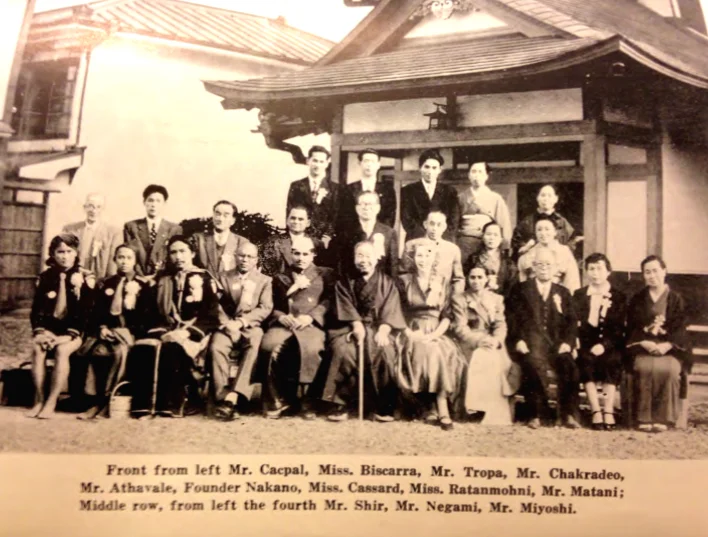
Transcriptions from 1954 'Second World Religious Congress' (Japan)
Transcriptions of the first speech given by the Om Mandli sisters at the 2nd World Religious Congress in Japan, 1954. Rich and illuminating! It really gives a feel of the time, their dedication and earnest good will to restore humanity to its most ideal state.
"God’s Dear Ones,
OM……… OM……..OM.
Before I take to the exposition of the views of my Order on topics included in the Agenda, let us all first establish ourselves in perfect silence for a short while. For, originally, we were all-silent. In that state, we experienced supreme peace and bliss. Let us, therefore, all be calm for sometime. I mean, let us become our real selves and thus regain that lost realm of tranquility which is our Godly patrimonial right, for, our Father Almighty, you know, is all-calm."
Above is an extract from the first speech given by Miss Prakashmani and Miss Rattan Mohini in Japan 1954 at the Second World Religious Congress. They would participate in two more through 1954 and 1955. It is fascinating reading and shows a period of the development of BK understanding previously unclear. Their understanding in the 1950s was distinct to their earlier understanding of the 1930s and 1940s as well as not yet being the fully formed body of knowledge that exists today on the post-1969 BK path.
Apologies for taking a while to get this together and publish the documents. I've finally started transcribing to render it printable as well as searchable (mainly the former). I will post up links to the original documents as well, but for now here is the first of what will be around five or six speeches and messages of the time. The beautiful words of Dadi Prakashmani and Dadi Ratan Mohini (probably authored or at least translated by our wonderful Dada Anand Kishore).
Enjoy!
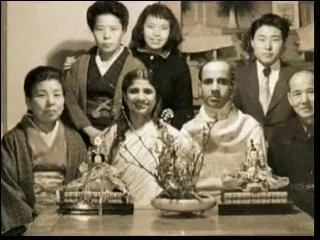
Miss Prakashmani speaks
"In those days everything was different," she said. "First, we always sat with a lot of attention in meditation. There was never any leaning against this or that. We had to be awake and alert" She sat upright and at attention, pulling herself away from the back of the mustard colored vinyl couch. "Not like this," she said, as she crossed her arms and leaned into the corner of the couch, gazing around. The class giggled knowingly. Dadi continued:
I remember Dadi Prakashmani telling us in the 80s and even in the 90s about the "early days". I remember very clearly sitting on the floor in the history hall while she was preparing to giving us our gift of either a 'rajai' (quilt)/ framed picture of Brahma Baba/ or sari. I always chose the rajai. She was just finishing arranging the gifts around her so she could show us the gifts, when someone asked what it was like in the early days. She put down the rajai, threw her hands in the air and looked up towards the sky. "Wah Baba!" Then she looked down at us and was so engaged. She really spoke to people with full attention and respect. "In those days everything was different," she said. "First, we always sat with a lot of attention in meditation. There was never any leaning against this or that. We had to be awake and alert" She sat upright and at attention, pulling herself away from the back of the mustard colored vinyl couch. "Not like this," she said, as she crossed her arms and leaned into the corner of the couch, gazing around. The class giggled knowingly. Dadi continued, "There was more love but less knowledge. Baba would tell us anything and we would just do it. No question about anything. Not even for a second." She crossed her legs and leaned into the class. We all leaned forward to listen. "Our understanding has changed a lot. Back then we thought Brahma Baba was God and that everything would finish quickly and we would all go together. Now our understanding has become refined. There is a lot of service still to do. We had to churn the butter. Now everything has been prepared for you. We didn't understand anything." Again she threw her hands up in the air with an expression of great love and abandon, smiling. Then she looked at us deeply and pointed to all of us in turn "Now you understand everything."
Here are some extracts of their understanding in the mid 1950s.
"Through this Divine Insight on this and several other occasions, God reveals to us many Godly secrets and scenes in advance including His many Godly forms... World God Father Himself with whom we have been maintaining constant communion since the last 17 years through His own Corporeal ordinary human forms in the names of World Almighty Goddess Mother Sri Jagadamba Saraswati and World Almighty God Father Brahma"
- Mr Anand Kishore
"We have visualized through Godly Insight the actual form of the Surpeme Soul, call God. It is very familiar and is commonly worshipped in temples in India and in most other countries. It is a most radiant, oval-shaped ball-like form of unbearable Light, called Jyotirlingum, visualized as Infinite Divine Light. The form is full of life. This is also called Shiva Lingum... His chief trinity forms as Brahma, the Creator, Vishnu, the Sustainer and Narayana, and Shiva the Destroyer, His bifurcated forms of Sri Lakshmi and Sri Narayana, the sovereigns of the ensuing Golden Age and the soul world, the subtle world, called Heaven in this corporeal world."
- Miss Prakashmani
It is apparent how their understanding refined over time. You can see they fully understand and appreciate the bright and awake living energy of God. The concept of omnipresence has disappeared, however the refined understanding of all souls having the form of points of light is not there yet. They understand the three worlds and the various activities of God, but they interpret the varied activities of God as meaning that God has a variety of forms. Current understanding is that the Supreme Soul has one form, the same as all souls, a point of radiant sentient light.

The need for history and research
As with all religious movements, there is a clear ideal and core body of knowledge established among the founder and first generation. As time goes by, recollections of these often take the form of stories that tell of great virtue and strength against remarkable adversity and hardship. The Brahma Kumaris is no different, no less than the Church, and the story of origin of this curious organization, is compelling.
This morning I was reading a book by David Hulme, the editor of the journal 'Vision', called 'Apostles: First Followers and Their Faith (Vision Media Publishing, 2010)'. The following is an excerpt from the foreword of the book, that made me reflect on some discussions that are currently taking place within the Brahma Kumaris about changes within the organization. Hulmes comments are in italics. My comments follow.
By the first part of the second century, (the early New Testament Church that had grown so quickly in numbers and spiritual strength in the first century), had all but disappeared in the historical record… it was as if a great curtain came down on the Church… When the curtain began to rise again 20 years later, the church that emerged was very different from the body the apostles had nurtured.
As with all religious movements, there is a clear ideal and core body of knowledge established among the founder and first generation. As time goes by, recollections of these often take the form of stories that tell of great virtue and strength against remarkable adversity and hardship. The Brahma Kumaris is no different, no less than the Church, and the story of origin of this curious organization, is compelling.
Since the passing of Dadi Prakashmani (1922-2007) who was widely considered an exemplar who lead the organization through decades of global expansion with grace, love, courage and humility, things have changed. The change has been acknowledged at all levels of the organization, and various attempts have been made to manage it. The challenge faced by everyone within the organization to some degree is to welcome the expansion while returning to the vision and ideals of practice, taught by the founder.
An attempt at this was Global Functioning. In 2007, the same year that Dadi Prakashmani passed, Global Functioning was established as an initiative to "review(ing) the needs of the Brahma Kumaris worldwide to assure that, with the expansion of the family and the growing complexity in these times, we have the right kinds of guidance available to BK center coordinators, main instruments (living at or supporting the centers,) and regular students... We want to assure that we have credible processes in place for applying our principles in the accurate running of the global organization in alignment with the laws and human rights conventions of the 21st century world and with our own Divine Constitution and other foundation documents. We are considering ways in which our guiding principles need to be updated to meet the demands of these changing times and of the expanded family." (Workbook for Moving Our Global Functioning Forward, 2008)
For the last seven years, there have been more committees, boards, groups, teams and levels of administration added than in the entire 75 years before that. Informal conversations among many indicate there is a concern at the increasing departure within the organization from the feeling of belonging, commitment, vision, love and practice of the ‘early days’. This ‘problem’ is not unique of course to the Brahma Kumaris. I return to David Hulme who speaks of the writings within the Christian Church, and whose reflections are relevant to the Brahma Kumaris:
Much of what has been written has come from authors who have filtered their conclusions through the traditions and teachings of a church farther and farther removed from the earliest believers… Few have labored to fully understand the teachings and practice of the first followers in their first-century cultural setting and their deep connection to the Hebrew Scriptures.
In a similar vein, there seems to be an attempt to modernize the Brahma Kumaris and to adapt and adjust to suit the needs of the world; To become legitimate, more new age, and more eclectically spiritual than spiritually revolutionary. The earliest Brahma Kumaris teachings were steeped in Hindu bhakti culture and broadly contextualized within understandings of the Shrimad Bhagawad Gita. The principles and lifestyle were influenced and effected by Hindu/ Muslim/ Sikh cultures who were each geographically and ideologically significant to the community. Yet, as with all religions, the path is held as an ideal of purity, as beyond influence, as above culture, as greater than tradition.
I believe a time has where we need to explore history and conduct research from within the organization, in a way that is self-inquiring rather that self-affirming, in a way that is self-explorative rather than self-congratulatory. This would be an exceptional act of humility and grace.
Perhaps it is time to offer a fresh perspective on a generation who really did provide timeless teachings. A perspective that acknowledges the heart of the teachings, while understanding that the teachings are profoundly influenced by tradition and exceedingly shaped by culture. A perspective that has the courage to look deeply within.