The Foundation Years (1932 - 1949)
Introduction
Social and Religious influences
Vedanta was a substantive influence in the early philosophy of the Brahma Kumaris, before their own distinctive understanding of the spiritual world developed in the post-1958 period. Read a summary of Advaita Vedanta by Patrizia Heise to understand the Brahma Kumaris' early thinking.
What is now known as the Brahma Kumaris began as Om Mandli, a spiritual community that developed in Hyderabad, Sindh, during the 1930s. Sometimes described within the community as the yagya, or sacred sacrificial fire, Om Mandli constituted a remarkable spiritual and social revolution in north-west India. Its teachings, practices and emerging forms of female leadership challenged established expectations around marriage, family, gender and religious authority.
The community developed during a period of profound social and political change in the Indian subcontinent. As young women and mothers became spiritual students, teachers and leaders, Om Mandli generated intense devotion among its members and considerable opposition within the surrounding community. The wider upheavals surrounding Partition later shaped the circumstances in which the group left the newly created Pakistan and relocated to India.
The Foundation Years
Lekhraj Koobchand Kripalani was born on the 15th December 1884 in Hyderabad, Sindh, into the family of a schoolmaster. He began his working life in the carpet trade before entering the diamond and jewellery business, eventually becoming a successful merchant and respected member of the Bhaibund community. Lekhraj was married to Jashoda and had five children, including daughters Palu Motriam Mukhi and Surya Kumari, and son Narain Kripalani. By the early 1930s, while still professionally successful and supporting a family, his attention was increasingly turning towards spiritual inquiry.
RENOUNCING
1931 Lekhraj Koobchand Kripalani, aged 47, and Sevakram Koobchand Daswani, of a similar age, are successful diamond merchants of the Bhaibund community, running the Lakhi Raj–Sevak Ram and Sons jewellery business in Calcutta. Although they work in Calcutta, both maintain family homes in Hyderabad, Sindh.
Bhai Lekhraj has a number of gurus from whom he seeks spiritual guidance. He holds these spiritual teachers in great respect and often offers them financial and practical support. Over the next few years, as his life undergoes significant change, his relationships with these gurus become increasingly important before eventually receding in significance.
1932 - 1934 Bhai Lekhraj becomes increasingly contemplative. Distracted from his business, he spends considerable time observing and questioning the workings of his own mind. On the advice of one of his gurus, he begins holding satsangs (religious gatherings) at a small property belonging to his uncle, Bherumal Kirpalani, also known as Vishwa Kishore.
Bhaibund men were often away for months, and sometimes years, conducting trade. As satsangs were regarded as a worthwhile use of time, Lekhraj invited women and children to attend. He read from the Bhagavad Gita, while others listened and participated.
January 1934 Lekhraj’s uncle, Kaka Mulchand, dies. A philanthropist much loved by Lekhraj, Kaka Mulchand had been an important influence on him, and his death appears to have deepened Lekhraj’s spiritual preoccupations.
To the distress of his childhood friend, business partner and confidant Sevakram, Lekhraj begins withdrawing from commercial life earlier than was socially expected. Still only 49, he turns increasingly towards spiritual inquiry and eventually sells his share of the business for a nominal amount in order to pursue this path more fully.
NB. In a number of later publications, Lekhraj’s birth year has been given as 1876. Contemporary documentary evidence, including newspaper reports, indicates a birth year of 1884.
His relatively young age at the time of his withdrawal from business is historically significant. Traditional Hindu expectations around vanaprastha, the later-life stage of withdrawal from household responsibilities, generally placed such renunciation later in life.
The age of sixty is referred to as saath (साठ), while saathiya (साठिया) can convey the sense of entering or approaching that stage of life. Lekhraj was saathiya, not saath, when he began his more intense spiritual inquiry and when the community started gathering around him. His comparatively young age was one of the points of criticism raised against him in contemporary accounts and newspaper reports.
CHANTING
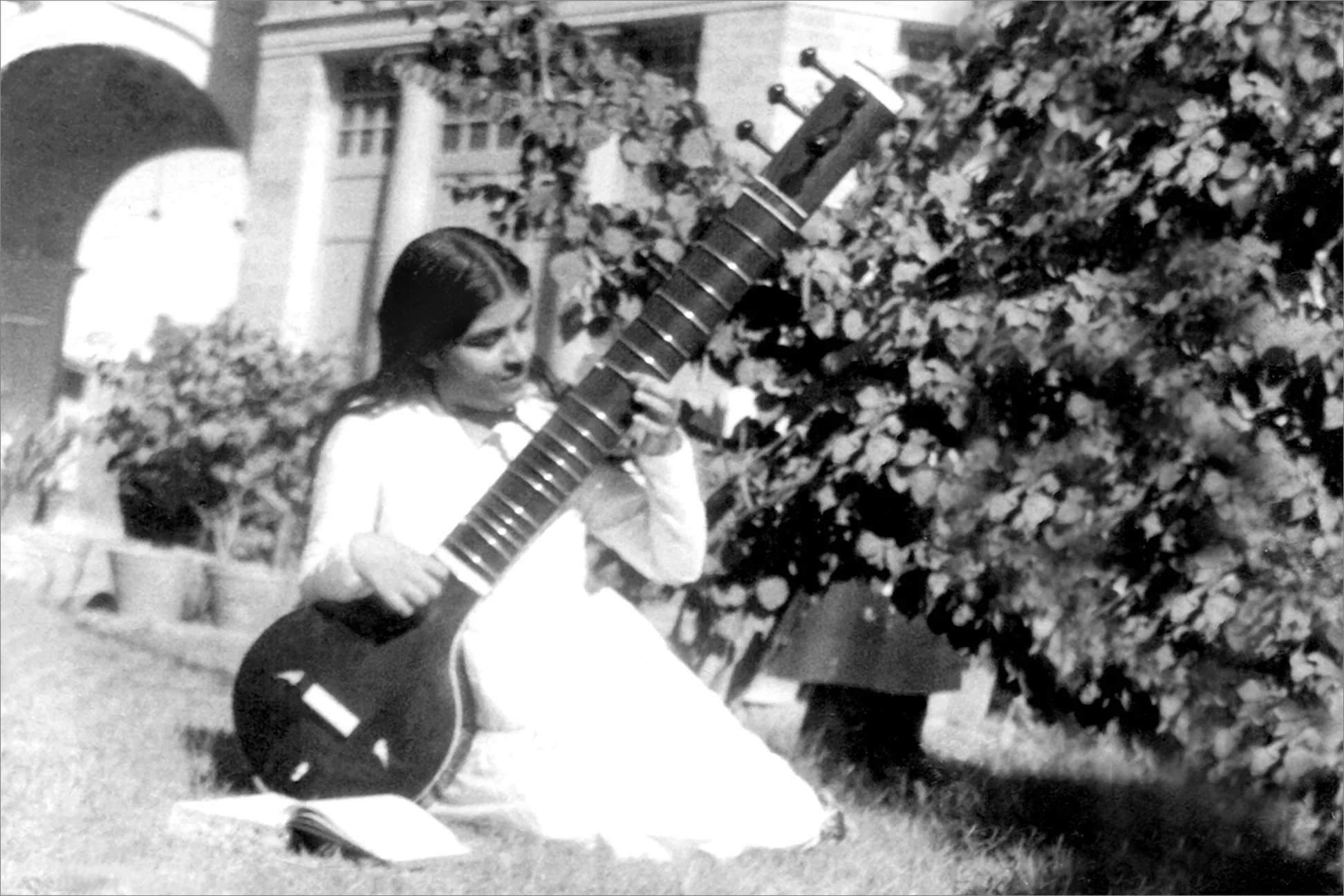
1935 The Om Mandli community begins chanting “Om” during its gatherings. Young girls and mothers enter trance states and report prolonged visionary and ecstatic experiences. Many describe seeing Lekhraj in the form of Krishna. As word spreads, family members and the wider community begin asking what is happening within these satsangs.
"Even though we were small we had so much intoxication that we are Gods children, like God. We used to consider outselves shivohum (I am Shiva). We didn't have the knowledge of God, the Cycle, the Tree, etc. Just I am a soul, and you are also a soul, and we were told about Shivohum. Baba used to get us intoxicated this way" (Gulzar, Page 30, Bestower of Fortune). Significantly, the understanding of the soul at this time was not yet that of an individual point of light, as it is in contemporary Brahma Kumaris teaching. Early recollections instead describe the soul in terms of divine or infinite light. "Sometimes when we children sat in solitude we would see each other as a soul; we never had other knowledge." (Gulzar, Page 32, Bestower of Fortune)
remembering (from 30 years later).
“The Father inspired me to do all of that. At that time, I was a child and there wasn’t full understanding. There was just the feeling that there was someone who was making me do all of that... At night, when I was sleeping, I felt as though I was flying. However, I didn’t understand anything. I just used to draw lines. I felt that there was some power that had entered me. I would be amazed. Previously, I used to do business etc. but then what happened was that I would look at some people and they would very quickly go into trance. I used to ask ‘What is happening?’ The eyes of whomever I looked at would close. When I asked those people what they saw they would reply that they saw Paradise or Krishna. This is why I went to Benares and renounced everything to try to understand. I used to sit there throughout the whole day. I would draw on a wall with a pencil and do no other business. I was a little baby! When I saw those things, I felt that I didn’t want to do any of that business , that I had to renounce my business etc. I was happy that I was leaving that donkey work. ”
One of the earliest clearly articulated teachings within the community concerned a 5000 year, endlessly repeating cycle of four ages, comprising four ages and a transitional fifth period, later known as the Confluence Age.
Cyclical understandings of time are present in many religious and cultural traditions. According to Lekhraj’s son, Narain Kripalani, who was part of Om Mandli from its earliest years, Lekhraj himself developed the distinctive 5,000-year formulation, its four equal periods and the relationship between the cycle and the four varnas or caste categories.
In this emerging framework, souls were understood to move through the Cycle of Time across the Golden, Silver, Copper and Iron Ages. These periods were associated respectively with Brahmin, Kshatriya, Vaishya and Shudra stages of consciousness. The precise development of this teaching is difficult to reconstruct, but the surviving material suggests that it emerged gradually through Lekhraj’s contemplation, discussion and visionary experience rather than appearing fully formed from the outset.
Outsiders began referring to Lekhraj’s satsang as Om Mandli, a name subsequently adopted by the community. Members increasingly referred to Lekhraj as Om Baba.
VISIONING
July 1936 Lekhraj travels to Kashmir intending to stay for one month, but remains for three. During his absence, some of the sisters continue the satsangs. "We children were crying day and night. Where did my Kiridhar Gopal (Krishna) go? We acted as if crazy, calling out 'Baba, Baba' and we were deperately distressed. For those months whenever we saw Baba Shri Krishna would appear". (Prakashmani, Page 7, Bestower of Fortune).
During Lekhraj’s absence, members of the yagya continue to report trance states and visions. On his return, he becomes increasingly convinced that another power is operating through him, although the identity of that power remains unclear. Many within the community, deeply affected by their experiences in his presence, increasingly regard him as a divine or incarnate figure.
As the community grows, Lekhraj begins holding more formal satsangs at his larger family home, Jashoda Niwas, in Hyderabad. Chanting “Om” becomes an established part of the gatherings. Members continue to report visions of Lekhraj as Vishnu, Krishna and as light.
During 1936, Lekhraj reports three particularly powerful visionary experiences: one of paradise, accompanied by profound joy and calm; one of destruction, accompanied by terror and sorrow; and one involving a number of Hindu deities, including Vishnu, Krishna, Jagannath, Badrinath and Kedarnath, accompanied by the repeated words, “You are this.” At this early stage, members of the Mandli variously refer to Lekhraj as Baba, Om Baba, Bhagwan and Mandli Mata.
Lekhraj also establishes a branch of Om Mandli in Karachi. Later accounts, including Adi Dev, describe Lekhraj as having a vision of points of light descending from the Soul World. The surviving early literature does not appear to support this account. The understanding of the soul as a point of light, and of a distinct Soul World, emerges more clearly in later material, particularly from the 1950s onwards. Interviews with early members also suggest that these teachings were not part of the community’s earliest cosmology.
This is consistent with later Sakar Murli recollections, which repeatedly refer to visions of destruction, paradise and divine forms, but do not describe an early vision of souls as points of light. "When he saw that he was going to become an emperor and he also had a vision of destruction and then a vision of his kingdom, faith was instilled in him that he was to become the master of the world" (Sakar Murli 16/10/2000). "As well as having the vision of the four-armed vision of Vishnu, there was also a vision of destruction. I realised that I was to receive the kingdom and that destruction would be taking place in just a few days." (Sakar Murli, 27/03/1999, page 89, quoted in Satyam Shivam Sundaram).
1937 By 1937, there was widespread understanding within the community that Lekhraj was either God incarnate or a form through which the Divine was directly present. "One early morning in 1937 I was walking with my father when we met Baba... He was laready known to us... I experienced lightness at once, and felt there was God in him. I thought at the time: he is my real father; he is God. I had been looking for God for a long time, and felt at last I had found God." (Janki, Page 12, Bestower of Fortune).

ENTRUSTING
October 1937 The Trust is established, and Lekhraj transfers his wealth and property to a group of senior sisters, while remaining in an advisory role.
In the months that follow, picketing and protest by close family members intensify. Much of the opposition centres on the community’s challenge to prevailing Hindu social expectations, particularly the empowerment of women and girls and the adoption of celibate lives within marriage.
At this stage, the community’s spiritual knowledge is still relatively limited, with particular emphasis on the Cycle and the soul. There is also a strong conviction that destruction is imminent, expressed in the belief that there will not be another Diwali.
The early understanding of the Cycle differs significantly from later Brahma Kumaris teaching. During the Golden and Silver Ages, consciousness is understood in terms of “I am Creator of Creation”, associated with unity. During the Copper and Iron Ages, the formulation becomes “I am God, but Creation is mere illusion”, associated with duality. There is great spiritual enthusiasm for the knowledge of the Drama, described in evocative terms such as the Eternal Creative Play and the World Bioscope. Members recognise a meeting or confluence between an old and new world, although the later, more developed teaching of a distinct Confluence Age has not yet emerged.
The understanding of the soul is also distinctly different from contemporary Brahma Kumaris Raja Yoga teaching. During the 1930s and 1940s, the soul is described through formulations such as Aham Brahm Asmi, “I am God”, or “I am the element of divine light”. The understanding of the soul as jyoti lingam, a sentient, thumb-shaped form of light, develops later, while the now familiar concept of the soul as jyoti bindu, a sentient point of light, emerges later still.
In this early period, there is not yet a clear distinction between God, the individual self and the realm of light referred to as Brahm. These distinctions gradually become more defined as the community’s theology develops.
Despite the still-forming nature of the teachings, members display remarkable spiritual confidence. They understand themselves as souls of the previous kalpa, or cycle of time, as the chosen instruments of world transformation and liberation from sorrow. Young women, children and men experiment with different states of consciousness and meditation. A powerful sense of love, belonging, purity and shared spiritual purpose sustains the community through many years of rudimentary and limited knowledge.
BANNING
October 1938
Following escalating protest and violence, the community relocates to Karachi and adopts the name Rajsuva Asvamedh Avinashi Gyan Yagya, the “indestructible sacred fire of knowledge in which the horse is sacrificed”. Members live across a small number of houses, with the principal residence at Clifton Beach, where the community also keeps a small herd of cows.
The opposition follows them to Karachi. A series of legal actions is brought by relatives of members seeking to restrict or disband Om Mandli.
March 1939
A tribunal considering the activities of Om Mandli recommends that the organisation be banned. The proceedings included testimony from Om Radhe, later known as Mama, concerning Lekhraj’s relationships and interactions with women in the community. The ban was not ultimately enforced, and Om Mandli continued living quietly at Clifton.
Around this time, Allah Bux, the Chief Minister of Sindh, is reported to have recommended that the community adopt a different name in order to reduce further legal difficulties. Om Mandli had originally been a name given to the group by the surrounding community. The organisation subsequently adopted the name Brahma Kumaris Ishwariya Vishwa Vidyalaya, the name it continues to use today.
1939–1942
Experiences of bodiless samadhi become increasingly prominent within the community. Members describe experiences of merging into the Brahm element and frequently speak of “light upon light”. Early images produced during the 1940s use the expression “Infinite Divine Light” around representations of the Cycle and the Tree, reflecting the language and spiritual understanding of this period.
Lekhraj begins writing notes in the mornings, which Mama reads to the class. Trance messengers regularly share their experiences with the community, and these accounts become another means through which spiritual understanding develops. The reading of the Bhagavad Gita gradually gives way to recording and studying teachings arising within the community itself, which are increasingly regarded as distinctive.
The legal and social opposition faced by the community appears to have strengthened its collective resolve. Convinced that its emerging spiritual understanding had significance beyond Om Mandli itself, members wrote to political and public figures including Gandhi, Princess Elizabeth, King George VI, the Viceroy and the Vicereine of India, urging spiritual and social transformation.
CLARIFYING
Clarifying
1942–1943
During this period, the role of Brahma becomes more clearly differentiated within the community’s emerging theology. A young sister, Pushpa, enters trance and a whispering voice begins speaking through her. This presence is referred to by Lekhraj as Piyu, meaning “the Beloved”.
The voice is experienced as distinct from Pushpa herself and attracts particular attention from Lekhraj, who increasingly understands it as evidence that another spiritual power or personality is involved in the experiences occurring within the community. Notes written by Lekhraj during this period come to be known as Piyu Vanis, or “versions of the Beloved”.
Piyu gives Lekhraj the name Brahma and helps clarify the role of Brahma as creator. Members increasingly refer to him as Prajapati Brahma or God Brahma, drawing on familiar devotional and scriptural imagery. At the same time, Lekhraj appears to distinguish between himself and the personality of Piyu, suggesting that the community’s understanding of divine agency is becoming more complex.
1943
During this period, Brahma relies significantly on trance messengers as part of the community’s continuing process of spiritual enquiry and interpretation. The language of the teachings still reflects formulations such as Manmanabhav and Aham Brahm Asmi, alongside identifications with Brahma and Vishnu.
In 1943, Gulzar Dadi reports an early experience of Avyakt Brahma in the Subtle Regions. This contributes to the developing understanding of three distinct realms or “worlds”. Experiences gained through trance, vision and contemplation continue to be interpreted through the language and imagery of the Bhagavad Gita and other familiar Hindu traditions.
From the 1940s into the early 1950s, Avyakt Brahma becomes an important source of spiritual understanding, knowledge and support within the community. At this stage, Avyakt Brahma is understood as a complete or perfected form of Brahma, although the later significance of this role does not become fully apparent until after Brahma Baba’s death in 1969 and the emergence of the combined form of BapDada.
Images produced during the 1940s continue to use the expression “Infinite Divine Light” around representations of the Cycle and the Tree. These images also identify Divine Father Gyan Surya with Brahma Baba and Divine Mother Gyan Chandrama with Mama. Changes between successive images, including the depiction of Brahma becoming Vishnu, Krishna and Narayan, provide useful evidence of the gradual development of the community’s theology.
During the Second World War, members interpret the conflict through the framework of the Mahabharata war and believe that the old world is approaching destruction. The anticipated date of 1950 also appears to have been linked to the scriptural motif of the Pandavas’ thirteen years of exile, with the community expecting a corresponding period between the formal establishment of the yagya and the end of the old world.

LEAVING
During the period associated with Piyu, the community experienced one of its earliest episodes of internal dissent. Sister Pushpa, through whom Piyu spoke, began to feel that her role as the chariot warranted particular recognition.
When Piyu was understood to be speaking through her, Baba and Mama accorded Pushpa special treatment, including particular food, fresh clothing and a designated seat. At other times, however, she was treated in the same way as the other members of the community.
Pushpa and a small number of others came to regard this distinction as unfair and eventually left the community. Some later accounts refer to this group as the “gossip group” or the “golden group”. One of the women who left was the biological sister of Dadi Janki, who later became Chief Administrative Head of the Brahma Kumaris.
CONCENTRATING
14 August 1947
Partition of India. The Om Mandli community maintains a period of silence, both to deepen their yoga practice and for their own protection. The high wall that Baba had earlier built around the community during the years of protest now also serves as protection amid the wider social and political violence of Partition.
1948
Shiv Baba speaks directly through Brahma Baba, rather than through Pushpa, using the same whispering voice that had previously been associated with Piyu. The word spoken is “Shivohum”.
Dada Anand Kishore understands this as confirmation that the personality of God is present. This understanding is not yet shared by everyone, but for some members an important distinction begins to emerge: Brahma is not himself God, and no human being can be God. Attention increasingly turns towards the presence of another spiritual personality working through him.
During this renewed experience of Piyu, some members remember seeing a more intense light on Brahma’s face and forehead from time to time. Others recall that Brahma’s face always seemed to shine, while some remember no particular outward difference.
1949
Brothers Vishwa Rattan and Chandrahas are given the task of illustrating new posters based on visions received by young sisters in trance. One trance messenger sees a Tree containing all religions, which Vishwa Rattan is asked to illustrate. The Cycle follows, illustrated by Chandrahas, along with the Trimurti.
Copies of the Cycle and Tree are sent to the British monarchy. Almost sixty years later, examples of these early materials are rediscovered by researchers in the British Library.
The posters continue to identify Brahma as Prajapati God Brahma. Baba corrected, finalised and authorised the material before printing, making these early documents and posters especially valuable evidence of the community’s spiritual understanding at the time.
This poster contains one of the early predictions of vinash or the catastrophic transition between the Iron Age and the Golden Age "World Almighty Authority Prajapati God Brahma has re-incarnated in ordinary human form along with His 108 most beloved self-conquering luckiest Divine Ones, males and females like Kalpa ago in Bharat on the banks of Sindhu Saraswari Tiver in the year 1937 A.D. and has organised the most supreme Rajsuva Asvamedh Avinishi Gyan Yagya which lasts for 12 years through the Divine power of Supreme 'Aham Brahma Asmi' Faith....the present final International Atomic War, the invention of science, a well as numerous Natural Calamities such as famines, fires, floods, earthquakes, storms, diseases etc shall, within a year or so, become the cause of merging innumerable Kali-Yugi Eastern and Western irreligions or dynastics into Infinite Divine Light like Kalpa ago."
The passage is particularly significant because it records both the identification of Brahma with divine authority at this stage and the expectation that world transformation, or vinash, was imminent.

May 1950 Baba directs all personal records from Pakistan to be left behind. Many are reluctant to leave their precious diaries, so Baba tells them to bury their books and that these would then be discovered on the path of bhakti and form the basis of the scriptures in the next kalpa. They move with few personal possession, but with their invaluable posters.
Om Mandli moves to Mount Abu and leases Brij Koti. Shortly afterwards they move to Pokhran House (Pandav Bhawan). They call the ashram Madhuban, named after the garden where Krishna played in the scriptures. Then in the early 1950s the Beggary Period begins, continuing for around 10 years.
Between 1952 and 1958, Shiv Baba is still thought of as thumb shaped. When God (Shiv Baba) was finally understood as a point of light, Baba asked the illustrators to go and put a white point inside every egg shape on every poster that depicted God. By end of the 1950s, it seem they understand Shiv Baba as a point of light. Therefore, the knowledge of the soul as a point of light is also clear. In posters drawn after the 1950s a distinct difference is that Infinite Divine light is replaced by the presence of Incorporeal God Shiva.