The Expansion Years (1970 - 2007)
Normally, Brahma Baba would give class in the evening. On 18 January 1969, however, he had been experiencing chest pain. Against his usual routine, Baba did not conduct morning class. Instead, he asked Ishu Dadi, the senior sister who looked after the mail, whether there were any unanswered letters, saying, “I want to clear all my accounts.”
After responding to the letters, Baba toured the kitchen and the new construction of the Training Section, near where they used to play badminton and close to the present site of Brahma Baba’s memorial, the Tower of Peace. Baba knew the children would be waiting for the murli, so he decided to give evening class early. The dinner bell rang earlier than usual and class was held at 8 pm.
After class, Baba stood at the door of the History Hall, gave drishti, looking at everyone with spiritual love, and said, “Tonight, Baba is taking leave.” He left, and senior sisters Kumarka, later known as Dadi Prakashmani, and Shantamani followed him. No-one realised the gravity of what Baba had said until later that evening.
In his room, Baba told Kumarka that he was feeling unwell and had a slight pain in his chest. She asked Shantamani to tell Vishwa Kishore to call the doctor. Vishwa Kishore left on his bicycle and returned with the doctor around fifteen minutes later. By then it was too late.
While they were waiting, Brahma Baba was in obvious pain before moving into a state of complete yoga, or connection with the Divine. During this time, Baba entrusted the leadership of the Brahma Kumaris to Dadi Prakashmani and Didi Manmohini (c. 1922–1985).
In 1969, many in Mount Abu wondered what would become of the Brahma Kumaris now that their founder had passed. It was a difficult time for the senior sisters. They had grown up with Baba and had never imagined a day when he would no longer be a physical presence in their lives. It fell to Dadi and Didi to guide the community through his passing and to continue as caretakers of the organisation.
After Baba had “left his body”, the soul of Brahma was reported to have entered a number of different sisters, including Sister Santiri, Sister Sheil Indra and Sister Gulzar, who later became the principal medium. There was initial uncertainty about how the teachings would continue. At the same time, the sense of spiritual urgency that had accompanied the community from its earliest years remained very much alive.
From 1966 through to 1974, Avyakt BapDada predicted 1976 as the date of vinash, or catastrophic world change. This would be followed by the liberation of all souls and the beginning of a new Cycle of Time, with souls either in the deep peace of liberation, Nirvana, or experiencing liberation in life in the peace and abundance of the Golden Age.
Many in the community, while mourning the passing of their founder, were also wondering what would happen next. Under the guidance of Didi Manmohini and Dadi Prakashmani, the organisation flourished. International service began, and foreigners started coming to India and claiming the path as theirs, with as much love and dedication as many of the earliest members. Many still remain.
As with many new religious movements, dates have come and gone. The sense of urgency, however, remains, with the continuing feeling that “time is short” and that things may happen “suddenly”. This awareness has remained an important part of the spiritual culture of the Brahma Kumaris and has been reinforced through the teachings of BapDada.
More about predictions within the Brahma Kumaris teachings can be found here.
Dissemination and Service
Key events
chronology
1959 to 1970 Classes were conducted primarily in the homes of BKs, before dedicated centres became more widely established.
1970 The first overseas centre is established in Slough, United Kingdom, in the home of Nirmala Bakshi and Suman Bakshi, who would later begin service in Germany. Brother Shiv Kumar teaches meditation and gives discourses in knowledge. A small group of local people become deeply interested in the teachings.
1971 An inaugural group of BKs from India is sent to support this early service. The delegation of five includes Brothers Jagdish and Ramesh, and Sisters Sheil Indra, Rosie and Nirmala. Nirmala continues the service in Slough before later travelling to Australia, where she begins service there.

Dec 6, 1975, The Age (melbourne). One of the first advertisements upon Dr Nirmala's arrival in Australia
October 1971 The seminal Raja Yoga centre is established in Tennyson Road. Senior sisters come and go to sustain the centre, including Nirmala and Rattan Mohini. It would be almost three years before Dadi Janki established a more permanent presence in London.
1974 Dadi Janki travels from India to London and establishes a sustained international presence. Beginning with the small house at 96 Tennyson Road in Kilburn, she remains in the United Kingdom for four years before returning to India. With remarkable courage and resolve, Dadi Janki helped establish the foundations of international service that would later expand across more than 120 countries.
1975 Service begins in Australia.
1977 Dadi Prakashmani travels to New York and visits the United Nations. Her vision is for the Brahma Kumaris to establish a presence there in support of the UN’s international work towards global peace. Around this time, the first centres are also established in the Americas.
1980 The Brahma Kumaris World Spiritual University gains affiliation as a Non-Governmental Organisation (NGO) with the United Nations Department of Public Information (DPI).

dadi janki giving address at a multi-faith gathering in the general assembly hall of the United Nations headquarters, New York. C. 2000
1983 The Brahma Kumaris are placed on the roster of the United Nations Economic and Social Council (ECOSOC).
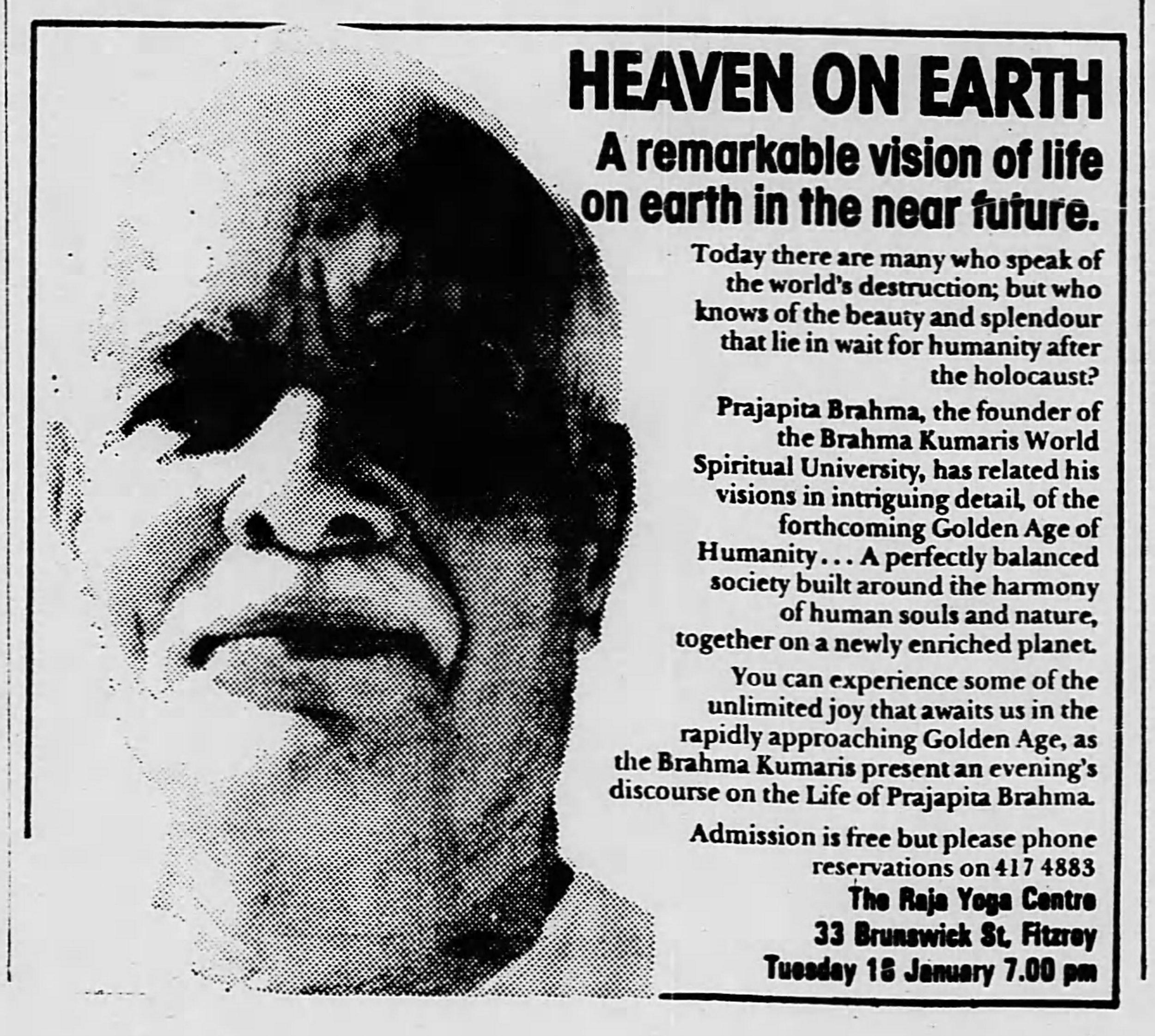
Jan 15, 1983, The Age (melbourne). past advertisements contained forthright theology and spiritual urgency
1998 The Brahma Kumaris are given general consultative status with ECOSOC, affording them the opportunity to contribute a spiritual expertise to matters of global concern, in a substantive way.
1990s Several retreat centres open in the United Kingdom, Kenya, the United States, Italy, South America and Australia, changing the face of service. From what had once been a relatively inward-looking community, the Brahma Kumaris develops a stronger outward gaze, offering an increasing range of services to the public.
From the mid-1990s into the mid-2000s, this expansion also requires the organisation to become more professional and accountable. For the first time, yogis and community members have to engage more systematically with matters such as child protection, insurance, mental health, disability access, occupational health and safety, and risk management.
There is now a growing need to abide by the laws of the state. Given the organisation’s history in Sindh, balancing spiritual law with worldly law becomes an increasingly important task, requiring care, negotiation and deliberation.
Digital communication changes the face of the organisation. Murlis begin to be distributed electronically rather than by post, enabling centres around the world to read the same murli on the same day. This brings a new form of cohesion, but also a degree of de-personalisation.
The internet also creates new public spaces in which current and former members can share criticism, disagreement and personal accounts of their experiences within the Brahma Kumaris.
2007 Under the leadership of Dadi Prakashmani, senior members in India and abroad begin a process of social research within the organisation, seeking to understand how people are feeling and how the Brahma Kumaris is functioning as an increasingly international community.
Global Functioning emerges as part of this process, asking what the organisation needs to do to operate responsibly within the systems of the world while continuing to honour the spiritual principles on which it is founded.
Dadi Prakashmani passes away. Her leadership and love leave a significant void within the community. Dadi Janki succeeds her in the leadership, accompanied by Dadi Gulzar and Dadi Rattan Mohini.
Around the same time, researchers begin uncovering original documents relating to the early history of the Brahma Kumaris. Many of those who could have answered questions about the earliest years have recently passed away, while others are elderly or no longer able to respond. As the first generation begins to disappear, there is a renewed urgency to recover the stories, memories and experiences of the early days.
Evolution of Knowledge
An early teaching image below illustrating the Brahma Kumaris understanding of the physical world, the Subtle Regions and the Soul World. Images such as this are valuable ethnographic records of how spiritual knowledge was visually communicated during the period of international expansion.

The Three worlds, C. 1977